

Concrete scanning
Before you core, drill or cut slabs, walls, beams or columns.
- Rebar and post-tension cables
- Electrical conduits and pipes in the slab
- Voids, and the safe spots to drill
GPR concrete scanning before coring and drilling, and ground scanning before excavation, anywhere in the UAE.
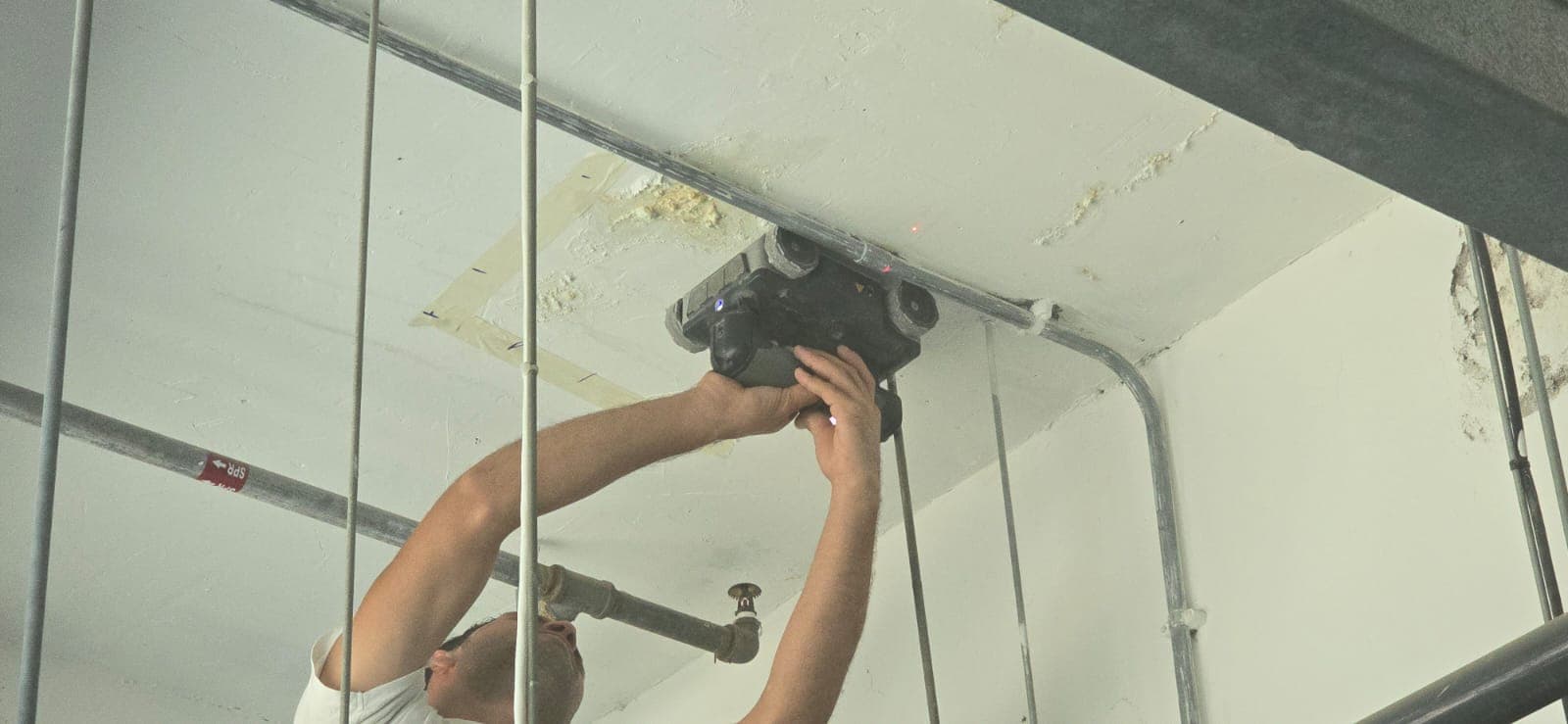
Before you core, drill or cut slabs, walls, beams or columns.

Before you excavate, trench or pile on roads, plots and yards.
DED Dubai trade licence 844806. Office in Deira, Dubai.
Quotes on WhatsApp within 1 hour during working hours. Dubai and Sharjah same day or next morning.
We mark what we find on the concrete or the ground, so your crew can work the same day.
The Dubai Mall, Yas Mall, Kempinski Hotel, Sheikh Khalifa Hospital and more.
Tell us the site, what you need to cut or dig, and your date. We reply with a price.
Our technician scans the area and marks every cable, pipe and bar on the surface.
You get a PDF report with the marked positions and depths for your file.
A few recent jobs. Client names are kept private.
Scanned the whole asphalt yard before the dig and marked each buried feature so the crew knew where to hand-dig.
Scanned the full garden in both directions before the pool was dug and sent the report the next day.
Scanned the full road corridor before new fire-protection pipework and marked every buried service on site.
Scanned the car park before excavation at several points and marked the buried services and their depths.
All seven emirates, from our office in Deira, Dubai.
Not sure whether your job needs a scan? Ask us. We will tell you straight.
GPR (ground penetrating radar) scanning sends low-power radio pulses into concrete or ground and records what reflects back, so you can see what is inside before you cut or dig. You need it before coring, drilling or saw cutting concrete, to find rebar, post-tension tendons and conduits, and before excavation, to find buried cables, pipes and ducts. We offer both: GPR concrete scanning and GPR ground scanning.
They are two different jobs. Concrete scanning looks inside slabs, walls, beams and columns for rebar, post-tension tendons, conduits and voids, typically up to 1.5 m deep. We do it before core cutting or drilling. Ground scanning uses a radar on a survey cart to map buried services in soil, up to 10 m in good ground. We do it before excavation. We use a separate scanner for each, so each job gets the right one.
In concrete GPR typically reads up to 1.5 m, and bars and tendons in a normal slab sit in the first 300 mm, where positions are typically within about ±10 mm. In the ground it reaches up to 10 m, usually 5 to 10 m in UAE soil: dry inland sand reads deep, saline sabkha and reclaimed coastal ground can pull it below 5 m. Congested reinforcement, wet concrete and saturated ground all reduce what radar can resolve, and we tell you on site when that applies.
On the day, findings are marked on the concrete or painted on the ground, with the safe positions shown for your crew. Within 24 hours you receive a PDF report with a marked-up layout, the position and depth of what we found, the positions we cleared, and any limits that affected the scan. For larger ground surveys we provide a drawing over your site plan, and 3D scan data is available on request.
Dubai and Sharjah: usually the same day or the next morning, subject to site access. Abu Dhabi: usually next day, longer where a permit to work has to be raised first. Al Ain, Ajman, Umm Al Quwain, Ras Al Khaimah and Fujairah: planned visits with a day's notice. We reply to WhatsApp quote requests within 1 hour during working hours, Sunday to Thursday 8 AM to 6 PM and Saturday 9 AM to 3 PM. Friday is closed. Night and weekend work in occupied buildings is arranged in advance.
It is priced mainly on the area scanned and the time on site, not the number of holes, because clearing one position still means scanning a zone around it. Twenty penetrations in one bay cost far less per hole than one isolated core in a large floor. Access, working hours and the report you need also move the price. Send the address and floor, roughly how much area, what the element is, whether the building is occupied and your date, and we will give you a fixed price before we come.
Always. Most UAE high-rise slabs are post-tensioned, and each strand carries roughly 140 to 200 kN. Cutting one releases that force at once and takes the tendon out of service along its full length; it cannot be repaired by filling the hole. We scan the zone around every position with GPR, mark the tendons and clear positions, and only then core. We do not core an unscanned post-tensioned slab.
Yes. Every excavation we do starts with a GPR ground survey of the dig area. We paint buried power cables, water and sewer lines, telecom ducts, plastic pipes, tanks and voids on the ground with estimated depths, and agree the safe dig limits before any machine breaks ground. Authority drawings and NOCs are still needed; the survey checks them against what is actually in the ground.
For most UAE jobs, yes, but not always. GPR works from one face, uses no radiation, needs no exclusion zone and shows results during the visit, so it works on occupied floors, ground slabs, rafts and walls against earth. X-ray needs access to both faces and the area cleared on both sides, but gives a sharper image in very congested reinforcement and separates objects stacked directly above one another. If you can reach both faces, clear the area and need that detail, X-ray is the better tool.
Yes. GPR emits low-power radio pulses and no ionising radiation, so there is no exclusion zone, no shielding and no need to clear the floor below. It is non-destructive: the scanner rolls over the surface and the only thing left behind is marker. That is why it suits trading malls, hotels, hospitals and occupied offices.
We stop and tell you before anything is cut. Usually the position can move a short distance, and we mark the nearest clear alternative so your crew can carry on the same visit. Where it cannot move, such as a fixed MEP penetration or a structural opening, that becomes a decision for your engineer or consultant, not something we cut through and report afterwards.
All seven: Dubai, Abu Dhabi (including Al Ain), Sharjah, Ajman, Umm Al Quwain, Ras Al Khaimah and Fujairah. We are based in Al Khabeesi, Deira, Dubai, where our scanners are kept, and bring everything needed to scan, mark and report on the same visit. Dubai, Abu Dhabi, Al Ain, Sharjah, Ajman, Ras Al Khaimah and Fujairah each have their own page for concrete scanning and for ground surveys.
Yes. A large share of our Dubai work is in trading malls, live hotels and occupied offices where the work happens at night or in shutdown windows. GPR needs no exclusion zone, so adjacent areas stay open. For core cutting in occupied buildings we contain the slurry and hand the area back clean. Where the building requires a permit or an escort for out-of-hours access, we work to its process.
From 12 mm to 500 mm diameter, in concrete, block and masonry, vertically, horizontally or overhead. Every hole is scanned with GPR first, so it goes into a cleared position.
Yes, as secondary services that follow the scan. We excavate to our own GPR ground survey, lay and re-level interlock paving and site roads, and provide route survey and escort support for oversized loads. Scanning is the core of what we do; these services exist so one contractor can carry the job from the survey to the finished work.
Tell us who to call. We reply within 1 hour during working hours, or message us directly.
Name and number are enough. Add the site and the job if you have them.